Monday, January 20, 2014


Kingfisher Chatter

(a blog about Assabet River National Wildlife Refuge)

NOTE: Enter your email address above and click "Submit" to subscribe/receive email when new Kingfisher Chatters are posted.  Also check out WWW.FARNWR.ORG to catch up on news, calendar and photos of Assabet River National Wildlife Refuge.


Click on photos below for larger views

20 Jan 2014


Lots to talk about since the last posting. 

Bird Survey (01/11/2014)

 John Milhaven led a winter bird survey at ARNWR on January 11th; a very foggy morning
Foggy walk down Winterberry Way

  Birds were not very plentiful but there were some good sightings including: 

  • Northern Cardinal
  • Cedar Waxwings
  • Golden-crowned Kinglets
  • Belted Kingfisher [ me ;-) ]
  • American Robin
  • Brown Creeper
  • American Robin
  • White-breasted Nuthatch
  • Black-capped Chickadee
  • Blue Jay
  • Mallard
  • Canada Goose
  • Tufted Titmouse
  • Northern Cardinal
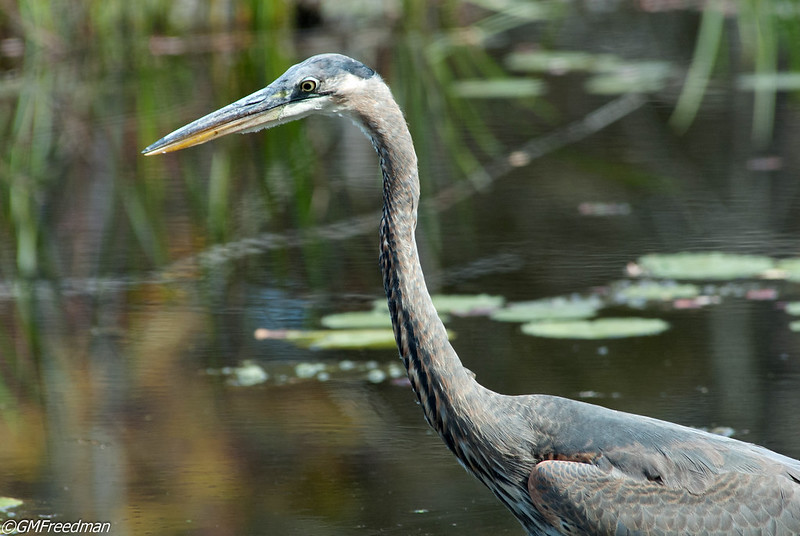
  • Great Blue Heron
  • Canada Geese
  • et al.
Cedar Waxwings
Evidence of Raccoon was seen in the snow at the footbridge on Winterberry Way.  Check out the footprint along with those of duck:
Raccoon footprint is in the lower circle and the duck prints are in the upper circle

Snow melt-back revealed Vole tunnels and trails in the snow

Vole trails and tunnels in the snow


Trail Cam

Recently a Whitetail Deer carcass was found along White Pond Rd Trail.  Bob K, one of the Refuge volunteers, dragged it off the trail into the woods.  Ranger Kizette notified Gary F who subsequently deployed a motion-activated trail camera aimed at the carcass with the hopes of identifying wildlife that comes to investigate and feed on the dead deer.  When there is sufficient light the camera records in color.  At night an infrared (IR) flash kicks in and it photographs in gray-scale tones.  When the sensor sees an animal the Trail Cam is set to take a picture every 30 seconds until the animal is out of view.  The Trail Cam has been in the field for a week now and has taken several interesting shots.  Below are sample pictures (note the date and time stamps in the lower right corner of the photos):


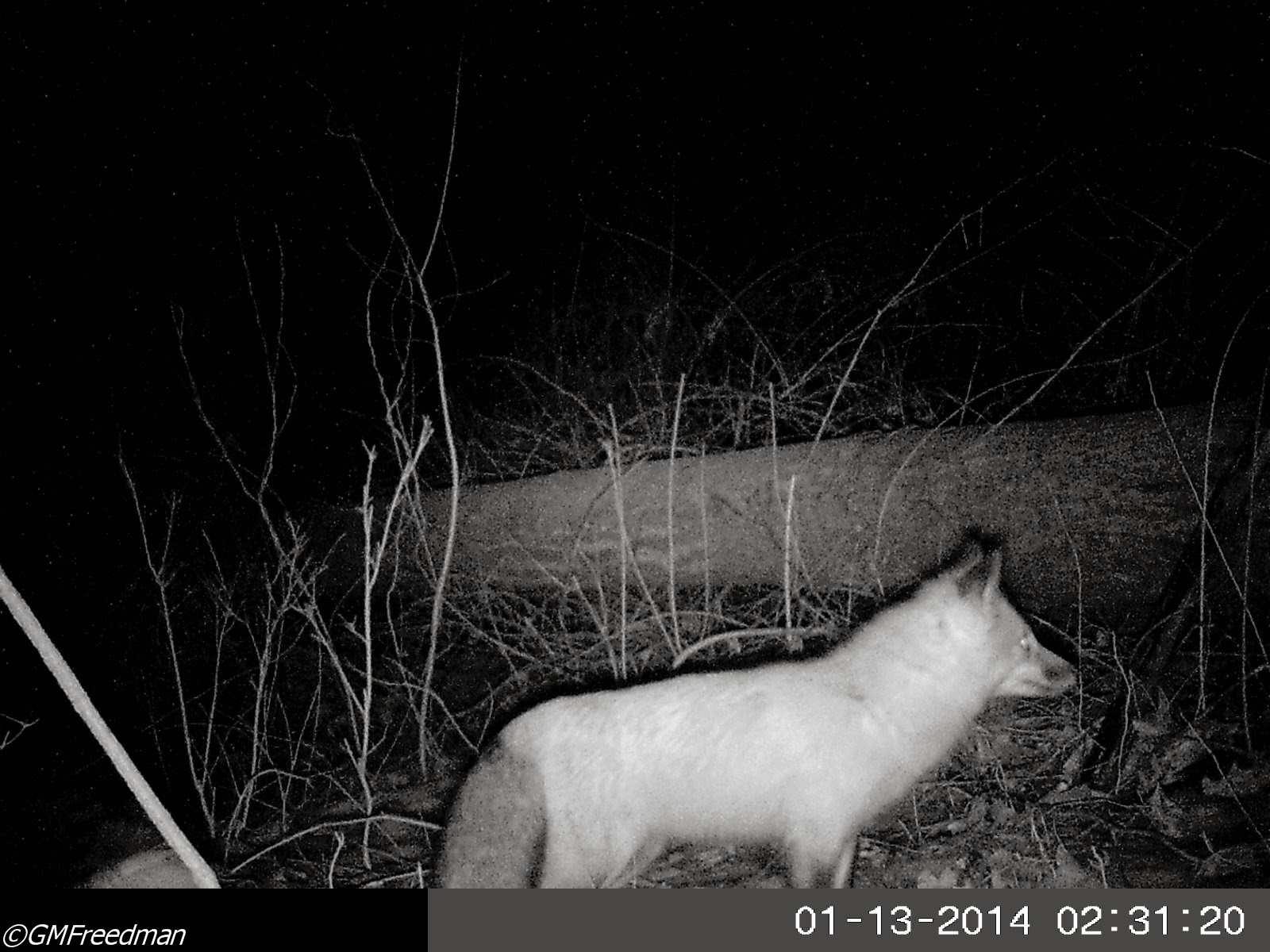
So far five animal species have been photographed feeding on the carcass including: Fisher; Red Fox; Red-tailed Hawk; Raccoon and Eastern Coyote .  Here are some samples from the several hundred photos (remember, you can click on the pictures for larger images):

Fisher

Fisher

 Red Fox
Red Fox

Red-tailed Hawk

Raccoon
Deer carcass as of 01/15/2014

Deer carcass as of 01/17/2014

Eastern Coyote

In addition to animals feeding on the carcass, humans were photographed off-trail by the Trail Cam (No!  Not feeding).  Apparently they followed the fur and blood from when the carcass was dragged off White Pond Rd. Trail  (see two photos below and note that the faces have been purposely blurred for publication):


Human

 Humans
Humans

Although Common Ravens are frequently seen in this part of the Refuge they aren't feeding on the carcass.  It could be that the Red-tail, also commonly seen in this area, is keeping other birds at bay.  It will be interesting to watch and confirm this behavior.  

Ranger Kizette is keenly interested in seeing a bobcat feeding on the deer.  To date there have been neither  bobcat photos on the Trail Cam nor tracks found in the vicinity.

Tomorrow, the next set of photos will be downloaded from the Trail Cam.  If there is anything new or interesting they will appear in another post shortly.  It is apparent that the dead deer will be a feeding site for a while longer.

Come visit Assabet River National Wildlife Refuge.  Observe the rules and enjoy.

--- The Kingfisher


Thursday, December 26, 2013


Kingfisher Chatter

(a blog about Assabet River National Wildlife Refuge)

NOTE: Enter your email address above and click "Submit" to subscribe/receive email when new Kingfisher Chatter posts are published.  Also check out WWW.FARNWR.ORG to catch up on news, calendar and photos of Assabet River National Wildlife Refuge.
Click on the photos below for larger views

20 Dec 2013

My Refuge is snow covered and very interesting now. 

By the footbridge on Winterberry Way the water was alive with tadpoles and even small Blue-gill sunfish.  The tadpoles were very large (~4 In. in length) so it is suspected they are Bull Frog.   Some tadpoles will go two to three years before their metamorphosis.  There are many factors including water temperature, oxygenation, food availability, overcrowding, to name a few.  As the ice gets thicker and oxygen levels drop there may be mass mortalities as evidenced last winter.  But for now they are wriggling and providing me (Kingfisher) and cousin Heron with a ready food source.   Yum!


Figure 3b    Here is a magnified view of one of the tadpoles from photo 3A.  A polarizing filter would have helped
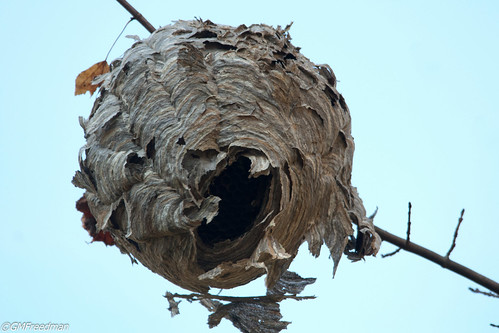
The Bald-faced Hornet’s nest that was photographed last summer and again in the fall (after being ravaged by critter(s) unknown), is now further torn apart. The comb center is now clearly visible in the photo below:

There are still plenty of other signs of life around me as evidenced by all the imprints and scat in the snow.


Great Blue Heron tracks were seen on the ice on either side of Otter Alley.


Two Herons were spotted.  One flew off and landed  behind the cattails.  One of the Herons can be seen If you look closely at the annotated picture below:


There was a dead Blue Jay on the trail near the footbridge on Taylor Way.  It had but one leg.  There were no signs of a struggle (neither loose feathers nor blood).   It is suspected that the leg was missing well before it died.


There’s a new bench by the footbridge on Taylor Way.  Hurray!  This is one of the most interesting wildlife watching areas on the refuge.  It is tied with Otter Alley for the best birding throughout the year.  It’ll be a nice place for breakfast, lunch or snack while watching nature.  Please pack out what you pack in!  Keep my refuge litter free. 
There were very few ducks seen.  Generally this time of year they hang out in the open water in the marsh between Taylor Way and Otter Alley.  Only Canada Geese were seen there this time.  Numerous duck did fly by but none landed in the open waters within the marsh.


Here is a complete list of birds seen/heard:
  • Blue Jays (Winterberry Way & Taylor Way)
  • Canada Geese (marsh between Otter Alley and Taylor Way)
  • Great Blue Herons (Otter Alley)
  • Eastern Phoebe (Taylor Way near footbridge)
  • Goldfinch (Taylor Way near footbridge)
  • Cedar Waxwing (Taylor Way near footbridge)
  • Sparrows (spp?)  in thicket and unable to identify
  • White-breasted Nuthatch
  • Red-breasted Nuthatch
  • Pileated Woodpecker (heard drumming...not seen (Taylor Way near footbridge)
  • Red-bellied Woodpecker (Otter Alley)
  • Mallards (fly-by only above Taylor Way footbridge) 
  • Flycatcher (sp?) (yellowish breast.  Too distant to identify or photograph)
  • Northern Cardinal
Hope to see you on the Refuge and wishing everyone a very happy and healthy 2014!

                  - The Kingfisher

Wednesday, November 20, 2013

20 Nov 2013: A blog about Assabet River National Wildlife Refuge

Kingfisher Chatter

(a blog about Assabet River National Wildlife Refuge)
 
NOTE: Enter your email address above to subscribe/receive email when new Kingfisher Chatter posts are published

20 November 2013


Click on pictures which are linked to the originals on FARNWR's Flickr account

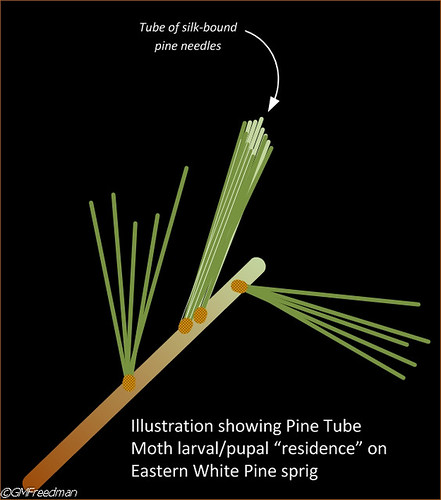
Have you heard of the Pine Tube Moth?  It was a new one to me!  Argyrotaenia pinatubana lives in pine trees and seems abundant in Eastern White Pine on the Refuge and well beyond too.   At this time of the year the Pine Tube Moth larva has bundled up to about 20 live pine needles with a silk it produces.  The bundle is fashioned into a tube; the binding silk on the inside of the tube.  The greenish-yellow larva (caterpillar) will eat some of the pine needles composing the tube from the tips down.  If too much is eaten it will build another tube.  Here is an illustration of a typical tube residence.
 
http://www.flickr.com/photos/91861642@N05/10927442944/


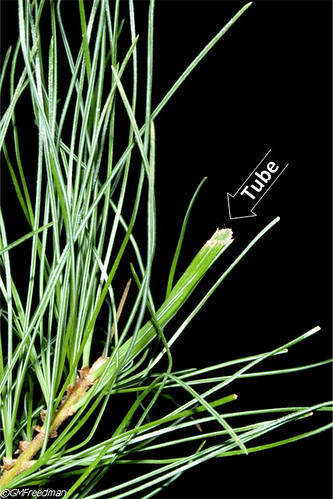
Below is is an actual Pine Tube Moth tube photographed on the Refuge.  Difficult to see unless one is looking for it.  Once you know what to look for you will find tubes are abundant.
 
http://www.flickr.com/photos/91861642@N05/10927442994/
 
 
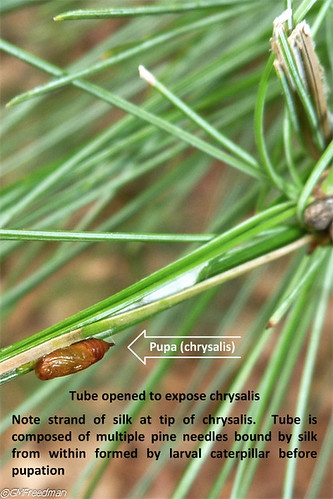
As the weather starts to cool, the larva pupates in a chrysalis as is typical for moths and butterflies.  The moth will emerge in the spring.  Hopefully next spring there will be a moth picture to post.  Here is a photo of the chrysalis from an opened tube
 
http://www.flickr.com/photos/91861642@N05/10927316075/ 
 
According to several sources, the Pine Tube Moth is a minor pest only effecting aesthetics as the tube needles, especially the tips, will generally brown.  It is found from Canada to Florida and west into Minnesota and Wisconsin.  Jack Pine Tube Moth is a similar species found in our western states.  In some areas two generations may occur in one season.
 
I'll be looking for caterpillars in the early summer and again in the fall and moths also.  Yum!  (Yes.  Belted Kingfisher will eat insects too)
 
Hope to see you at my Refuge.
 
- The Kingfisher -
 

Tuesday, November 19, 2013

19 Nov 2013: A blog about Assabet River National Wildlife Refuge

Kingfisher Chatter

(a blog about Assabet River National Wildlife Refuge)
 
NOTE: Enter your email address above to subscribe/receive email when new Kingfisher Chatter posts are published

19 November 2013


Click on pictures which are linked to the originals on FARNWR's Flickr account


The Refuge has been quiet but still plenty of things to see and do there. 
 
Birding with John M: John Milhaven led a morning birding walk last Saturday.  Here is a partial list of sightings:
  • Eastern Bluebird
  • Blue Jay
  • Northern Cardinal
  • Gold-crown Kinglet
  • Common Grackle
  • Canada Goose
  • Mallard Duck
  • Great Blue Heron
  • Black-capped Chickadee
  • Tufted Titmouse
  • Down Woodpecker
  • Hairy Woodpecker
  • Belted Kingfisher (that's me!)
  • American Goldfinch
  • Dark-eyed Junco (slate-colored variant)
 
Representative pictures of each of these species photographed on the Refuge can be found at: http://farnwr.org/gallery1.html
 
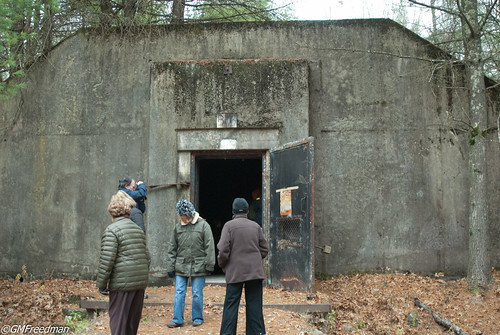
Bunker Tour: Jan Wright led a bunker tour last Sunday.  It started in the Visitor Center with her presentation on the history of the ARNWR land especially from the time of the government taking of the land by eminent domain in 1942 during WWII.  Residents were only given ten days to pack up and move out and construction of the ammo depot and bunkers commenced almost immediately. The site was used to store munitions from navy vessels docking in Boston Harbor and surroundings.  The ammo was removed to enhance the safety of the harbor in case of accident or attack.  It was carried by rail  to be stored in the bunkers (officially know as "igloos").  The site (now ARNWR) which touches Maynard, Stow, Hudson and Sudbury was just out of the range of enemy battleship firepower of the time making it a safer prospect than storing anywhere near the city. 
 
Following the war it served for troop training, munitions testing and numerous projects associated with the Army's Natick Labs.  Camo gear, parachutes and other materials and equipment were tested here.  Our Refuge was established in 2000 but it was not opened to the public until structures were demolished and Superfund cleanup was completed.
 
Bunker #303 was opened.  It was dark and echoey and remarkably clean and fresh smelling.  I would have expected dank!  Click on the image below to see photos from the tour.
 
 
http://www.flickr.com/photos/91861642@N05/sets/72157637780739776/
 
 
Flora & Flora Spotted Recently
 
Deer: spotted from a distance crossing Harry's Way near Kingfisher Trail.  These were very mature does, both unusually tall.  Legs too short for moose more reminiscent of elk but there are no Elk in this area.
 
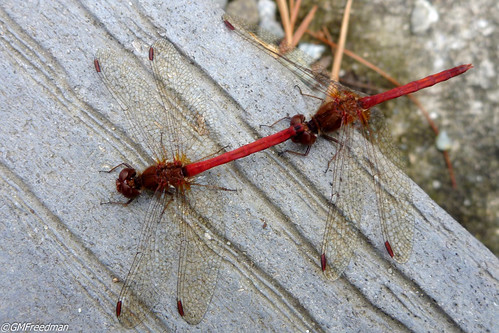
Yellow-legged Meadowhawk Dragonflies are still about, particularly around Puffer Pond. 
 
 http://www.flickr.com/photos/91861642@N05/10930137554/
 
Remarkably these two are both males in mating position!  Thanks to both Betty and Jini Foster for help with identification.
 

Here's what Betty Wright has to say about Yellow-legged Meadowhawk Dragonflies:
  • They are the only Meadowhawks to fly in November; the latest to fly
  • They can feed at temperatures below 50 degrees
  • Eyes are reddish brown
  • Brown to yellow basal wing patches
  • Early legs are dull yellowish; the older legs are dull brown
  • Lack of black on legs and usually less black on the sides of the abdomen distinguish this species from other Meadowhawks
Here are some other comments from Betty:On Kingfisher:  I saw a Kingfisher.  This surprised me, but according to David Sibley, while they will migrate, they will stay as far North as there is open water.  Mine could have been migrating or one that planned to winter here
 
On Earthworm: There is not a native earthworm in North America.  They are all invasives and come from Europe.  I am not sure whether we are better or worse for them

On Wintergreen: When I was much younger, the advice was to chew on Wintergreen leaves.  Now, people into herbal medicines like Arthur Haines say never chew the leaves


Betty will be a frequent contributor to this blog :-).  Welcome aboard Betty and thanks!

As the weather continues to cool the waterways within the Refuge will be resting place for migrating and returning waterfowl.  Keep an eye open for Mergansers, Buffleheads, Teal, Ring-necked Ducks and others.  Come on down and keep watch.   Though the Refuge is seemingly quiet there is a lot of work going on.  Beavers and muskrats are preparing and repairing their lodges and stockpiling materials for the long winter. Watch for their activity near sunrise and sunset.  Also look for new beaver work (gnawed and felled trees) along waterways.

Speaking of muskrats, Paulette Freedman will lead a Fledgling program this Friday (22 Nov) at 10:30AM with a focus on muskrats and cattails.  Age range for this is 2 to 5 year olds and will be held in the ARNWR Visitors Center.


See you on the Refuge.

- The Kingfisher - 


Wednesday, October 30, 2013


Kingfisher Chatter

(a blog about Assabet River National Wildlife Refuge)
 
NOTE: Enter your email address above to subscribe/receive email when new Kingfisher Chatter posts are published

30 October 2013

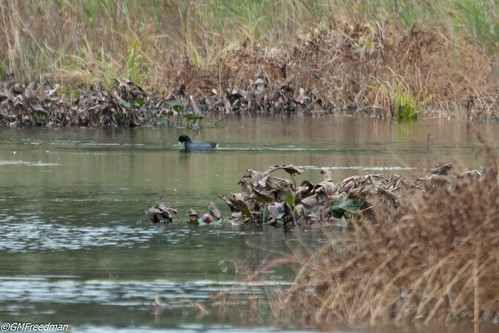
Its been cold at the Refuge.  Yesterday there was ice on the waterways and it closed in near-shore water pushing waterfowl further out and making viewing rather poor.  Many of my web-footed friends have come back from their extended vacation up north.  It is nice to have them back.  There have been lots of Canada Goose returning,  large numbers of Mallards and some American Black Duck mixed in.  I've seen American Coot
 
http://www.flickr.com/photos/91861642@N05/10483870556/in/photostream/
 
note the ivory bill (they used to be called Ivory-billed Coot).
 
 
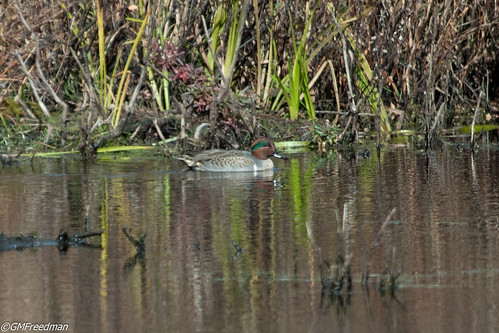
Blue-winged Teal and Green-winged Teal are  here too.  Here's a Green-wing Teal
 
http://www.flickr.com/photos/91861642@N05/10483859755/in/photostream/lightbox/
 
Still awaiting my Merganser friends and many other species.

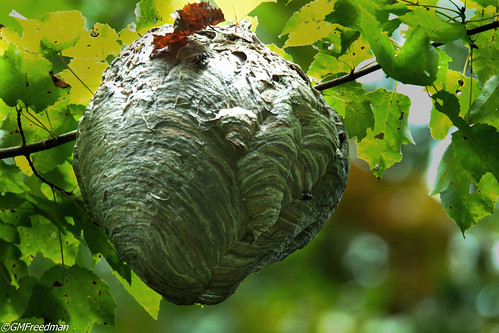
The Bald-faced Hornet nest above Taylor Way has been ransacked.  Check out the before and after   pictures.
 
Before
Before (09/14/2013)
 
After
After (10/21/2013)
 
Even though these "hornets" are very aggressive nest defenders by virtue of their sting, there are many birds and mammals that find them delicious and will tear apart the nest for a feast.  They always leave enough of the population to ensure a feast for next year.  By the way, the Bald-faced Hornet is a not a true hornet.  It is a member of the Yellowjacket/Wasp family.

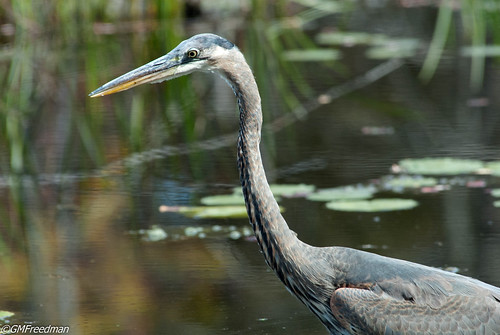
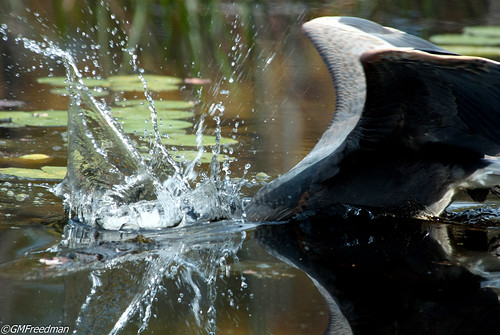
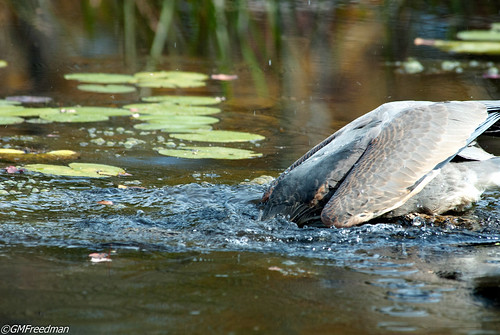
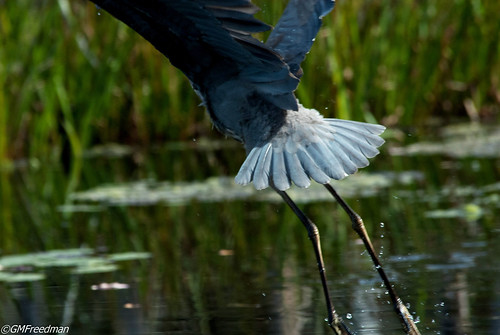
Great Blue Herons have been fattening up for the winter.  Check out this fishing sequence ending in the successful catch of a Hornpout Catfish near the footbridge on Taylor Way.  To view full size, click on each picture or click on the first one and use Flickr left arrow on the picture to navigate to the next one.

 
http://www.flickr.com/photos/91861642@N05/10431822683/in/photostream/
 
http://www.flickr.com/photos/91861642@N05/10431675636/in/photostream/
 
http://www.flickr.com/photos/91861642@N05/10431816723/in/photostream/
 
http://www.flickr.com/photos/91861642@N05/10431669456/in/photostream/
 
http://www.flickr.com/photos/91861642@N05/10431667736/in/photostream/
 
http://www.flickr.com/photos/91861642@N05/10431665826/in/photostream/
 
http://www.flickr.com/photos/91861642@N05/10431808713/in/photostream/
 
 
This Heron was a smart cookie and risk averse.  After the one fish was caught, it flew to dry land so the fish could be oriented headfirst flipped into the air and swallowed whole.  It was too hidden by the weeds to photograph this dining experience. 
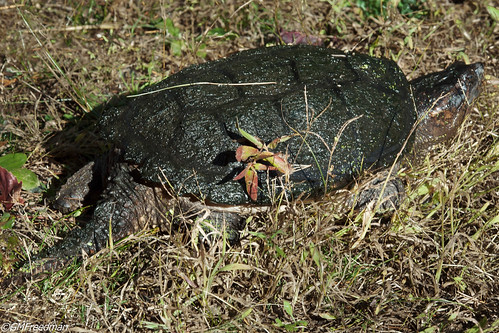
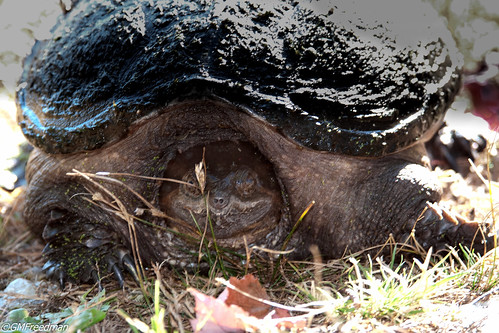
Two  Snapping Turtles have been seen recently; one on Taylor Way and another within minutes on Otter Alley.  Although formidable on land, they are shy and evasive in the water preferring to swiftly swim away from people and other animals.  Their temperament on land stems from the fact that these guys are so bulky that they can't fully retract into their shell for safety.  So Nature has favored them with a sharp beak and powerful jaw muscles.  Be careful around them on land as their necks are very long and agile.  they can reach back behind them to about 3/4 the length of their shell.   Here are a few pictures of one of the turtles (click on pictures for full size photos):

http://www.flickr.com/photos/91861642@N05/10431829633/in/photostream/lightbox/

http://www.flickr.com/photos/91861642@N05/10431827473/in/photostream/lightbox/


There are still some Warblers hanging around although the bulk of the autumn Warbler migration seems to be over.  There is also a decided lower population of insects visible now that the frosts have hit.
Squirrels and Chipmunks are abundant and busy knocking acorns from the Oaks for collection and storage.  Although Muskrats and Beavers should be busy now, only one Muskrat has been sited recently and that was in the water near the footbridge on Taylor Way.
Raccoon poop was found on the bench at the end of Kingfisher Trail.  Coyotes must be fattening up too as there seems to be more scat about and also more bird feathers on the trails.
Don't forget to check out more about Assabet River National Wildlife Refuge online: 
Also let me know if you have any questions, comments, sightings by posting comments to this blog or emailing kingfisherchatter@gmail.com
 
Hope to see you soon.
The Kingfisher